How GPU Cloud Services Enable Faster AI-Driven Predictive Analytics

TL;DR: Accelerating Predictive Analytics with GPU Cloud Services
Leverage GPU cloud platforms to train AI models faster and process larger datasets.
Use parallel processing to enable real-time predictive analytics and low-latency inference.
Improve prediction accuracy by supporting deeper, more complex models and iterative experimentation.
Optimize workflows with GPU-accelerated libraries (TensorFlow, PyTorch, RAPIDS) and scalable cloud clusters.
Implement predictive maintenance, personalization, and dynamic decision-making at scale.
Reduce costs and increase flexibility by scaling GPU resources elastically and choosing the right cloud provider.
Adopt managed GPU cloud services to focus on analytics and model development while providers handle infrastructure.
Artificial intelligence (AI) and predictive analytics have become the backbone of modern business intelligence, powering everything from customer insights to predictive maintenance and real-time decision-making. As data volumes explode and models become more sophisticated, the demand for faster, scalable, and more accurate analytics has never been higher. Enter GPU cloud services-a transformative technology that is redefining how organizations approach AI-driven predictive analytics.
How GPU Cloud Boosts Predictive Analytics Performance
Traditional predictive analytics, powered by CPUs, often struggle with the scale and complexity of today’s data workloads. CPUs are designed for sequential processing, making them less efficient for the parallel computations required in modern AI and machine learning (ML) tasks. GPUs, on the other hand, are engineered for parallelism, with thousands of cores capable of handling multiple operations simultaneously. This architectural advantage translates into several key benefits for predictive analytics:
Accelerated Model Training: Training deep learning and complex ML models can take days or even weeks on CPUs. GPUs slash this time dramatically, often completing training in hours or even minutes.
Real-Time Predictive Analytics: The speed of GPUs enables real-time data processing and prediction, a crucial capability for applications like fraud detection, dynamic pricing, and predictive maintenance.
Enhanced Prediction Accuracy: By enabling the use of more complex models and larger datasets, GPUs help data scientists achieve higher prediction accuracy.
Scalability and Flexibility: GPU cloud services allow organizations to scale resources up or down based on workload demands, ensuring cost-efficiency and agility.
Use of GPU in AI-Driven Forecasting
Forecasting models, especially those leveraging deep learning, require immense computational power to process historical data, identify patterns, and generate accurate predictions. GPUs excel in this domain by:
Parallelizing Data Processing: Breaking down large datasets into smaller fragments and processing them simultaneously, resulting in faster throughput and reduced latency.
Supporting Advanced Algorithms: Enabling the use of sophisticated neural networks (CNNs, RNNs, Transformers) that are otherwise impractical on CPUs due to their computational demands.
Facilitating Iterative Experimentation: Rapid training allows data scientists to experiment with multiple models and hyperparameters, leading to better-optimized solutions.
Enhancing Prediction Accuracy with GPU Cloud
Prediction accuracy is a critical metric in AI-powered predictive analytics. GPU cloud services contribute to higher accuracy in several ways:
Processing Larger Datasets: GPUs can handle vast amounts of data, ensuring that models are trained on comprehensive datasets, which improves generalization and reduces bias.
Enabling Deeper Models: The computational power of GPUs allows for deeper and more complex neural networks, which can capture intricate patterns in data.
Faster Iteration Cycles: With reduced training times, data scientists can iterate more frequently, refining models and achieving higher accuracy.
Fast Training of AI Models with GPU Cloud Services
One of the most significant advantages of GPU cloud services is the dramatic reduction in training time for AI models. As illustrated in the graph below, training time on GPU cloud platforms can be a fraction of what is required on CPU-only systems, while also improving prediction accuracy.
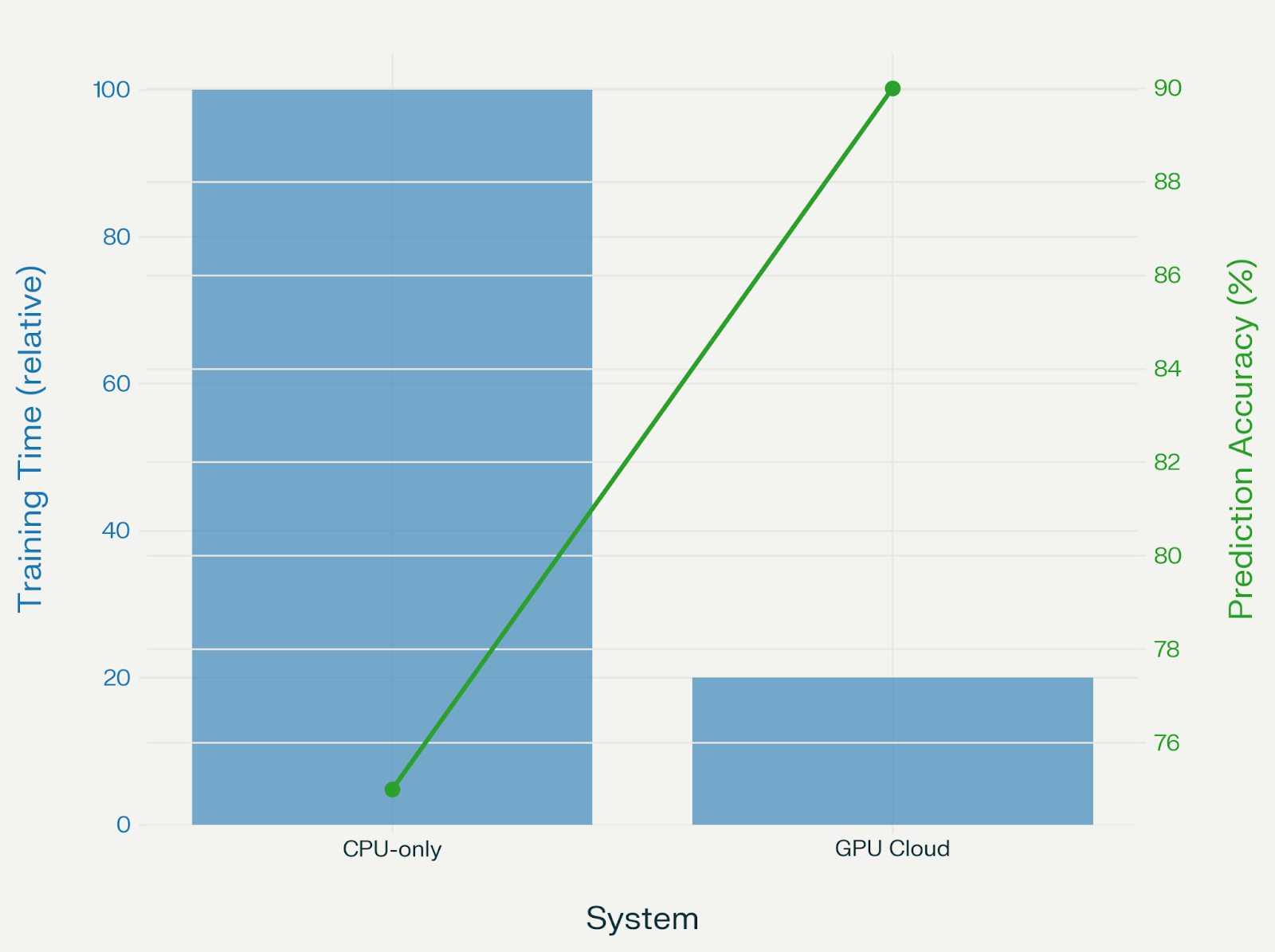
GPU cloud platforms can reduce training time by up to 80% or more compared to CPU-only systems.
- Prediction Accuracy: Models trained on GPU clouds often achieve higher accuracy, thanks to the ability to use more data and complex architectures.
Cloud GPUs for Data Science
Data science workflows, from data preprocessing to model deployment, benefit immensely from GPU acceleration:
End-to-End Acceleration: Libraries like RAPIDS, TensorFlow, and PyTorch are optimized for GPU execution, enabling faster data manipulation, feature engineering, and model training.
Cost Efficiency: By reducing infrastructure costs and increasing throughput, GPU cloud services offer a compelling ROI for data science teams.
Accessibility: Cloud platforms democratize access to high-performance GPUs, allowing organizations of all sizes to leverage cutting-edge hardware without significant upfront investment.
Real-Time Predictive Analytics and AI Model Acceleration
Industries such as finance, healthcare, and manufacturing increasingly rely on real-time analytics to drive critical decisions. GPU cloud services make real-time predictive analytics feasible by:
Low-Latency Inference: GPUs accelerate not only training but also inference, enabling rapid predictions on live data streams.
AI Model Acceleration: Tasks like image recognition, natural language processing, and anomaly detection are dramatically sped up, supporting applications that require instant responses.
Deep Learning on Cloud GPUs
Deep learning has revolutionized predictive analytics, but its computational demands are immense. Cloud GPUs are purpose-built for deep learning workloads:
Scalable AI Infrastructure: Cloud providers offer elastic GPU clusters, allowing organizations to scale resources as needed for training and inference.
Support for Popular Frameworks: Platforms come pre-configured with frameworks like TensorFlow, PyTorch, and Keras, streamlining development and deployment.
Distributed Training: Multi-GPU and multi-node setups enable distributed training, further reducing time-to-insight for large-scale deep learning projects.
Predictive Analytics with AI: The GPU Advantage
Predictive analytics powered by AI is transforming sectors from retail to energy. Key advantages of using GPU cloud services include:
Accelerated AI Analytics: GPUs enable faster data processing, model training, and inference, resulting in more timely and actionable insights.
Predictive Maintenance: In manufacturing and IT, GPU-accelerated analytics help predict equipment failures, optimize maintenance schedules, and reduce downtime.
Personalization and Recommendation: Retailers and online platforms leverage GPU-powered models to deliver personalized recommendations and dynamic pricing in real time.
Best GPU Cloud Platform for AI and Analytics
Choosing the right GPU cloud platform is crucial for maximizing performance and cost-efficiency. Leading providers include:
| Provider | Key Features |
| NeevCloud | India’s first AI SuperCloud; top-tier NVIDIA GPUs (A100, GB200, V100); multi-GPU configurations; real-time analytics; 10Gbps backend; lowest global prices; transparent billing; AI-optimized data centers; supports all major AI frameworks; scalable, secure, and energy-efficient; tailored for enterprises and startups; 24/7 AI/ML support. |
| Liquid Web | Bare metal GPU hosting, NVIDIA L4/L40S/H100s, pre-configured AI/ML frameworks, flexible plans |
| Google Cloud | Wide range of NVIDIA GPUs, seamless integration with AI/ML tools, global availability |
| Amazon AWS | EC2 P4/P5 instances with NVIDIA A100/H100, managed ML services, scalable clusters |
| Microsoft Azure | ND/NV series VMs, deep learning optimizations, enterprise-grade security and support |
| Paperspace | User-friendly platform, affordable GPU rentals, Jupyter notebooks, team collaboration |
| Lambda Labs | High-performance GPU clusters, optimized for deep learning, research-focused |
| OVH Cloud | Cost-effective GPU servers, European data centers, flexible billing |
These platforms offer a range of options, from on-demand GPU instances to dedicated bare metal servers, ensuring that organizations can find the right fit for their AI and analytics workloads.
GPU for Machine Learning: Accelerated AI Analytics in Action
The impact of GPU cloud services on machine learning is profound:
Speed: Training times are reduced from weeks to hours, enabling rapid prototyping and deployment.
Scale: Handle terabytes of data and millions of parameters with ease, supporting enterprise-scale analytics.
Accuracy: Leverage advanced algorithms and larger datasets for more reliable predictions.
Predictive Maintenance: A Real-World Example
Predictive maintenance is a prime use case for GPU-accelerated analytics. By analyzing sensor data from machinery in real time, AI models can predict failures before they occur, minimizing downtime and maintenance costs. GPU cloud services enable:
Rapid Data Processing: Handle high-frequency sensor streams and large historical datasets.
Complex Model Deployment: Support advanced deep learning models that can detect subtle patterns indicative of impending failures.
Scalable Monitoring: Monitor thousands of assets simultaneously, scaling resources as needed.
Scalable AI Infrastructure: The Future of Predictive Analytics
As AI-driven predictive analytics becomes more integral to business operations, the need for scalable, flexible, and high-performance infrastructure grows. GPU cloud services deliver on this promise by:
Elastic Resource Provisioning: Instantly scale up or down based on workload demands.
Global Accessibility: Access GPU resources from anywhere, supporting distributed teams and global operations.
Managed Services: Focus on model development and analytics, while cloud providers handle infrastructure management and optimization.
FAQs
How do GPU cloud services improve predictive analytics performance?
GPU cloud services accelerate AI model training and inference by leveraging thousands of parallel cores, enabling faster processing of large datasets, real-time predictions, and the ability to use more complex models, resulting in higher accuracy and actionable insights.
Why are GPUs better than CPUs for AI-driven forecasting?
Unlike CPUs, which process tasks sequentially, GPUs handle thousands of operations simultaneously. This parallelism allows deep learning models to process historical data, detect patterns, and generate predictions much faster, supporting iterative experimentation and complex algorithms.
How can GPU cloud services enhance prediction accuracy?
By processing larger datasets and supporting deeper neural networks, GPUs allow models to capture intricate patterns in data. Faster training cycles also let data scientists iterate more frequently, refining models and improving overall prediction reliability.
Conclusion
GPU cloud services are revolutionizing AI-driven predictive analytics by delivering unparalleled speed, scalability, and accuracy. Whether you’re training deep learning models, deploying real-time analytics, or scaling predictive maintenance solutions, the advantages of GPU acceleration are clear:
Faster model training and inference
Higher prediction accuracy
Cost-effective, scalable infrastructure
Support for advanced AI and deep learning frameworks
Real-time analytics for mission-critical applications
Organizations that harness the power of GPU cloud services are better positioned to unlock the full potential of AI-powered predictive analytics, driving innovation, efficiency, and competitive advantage.