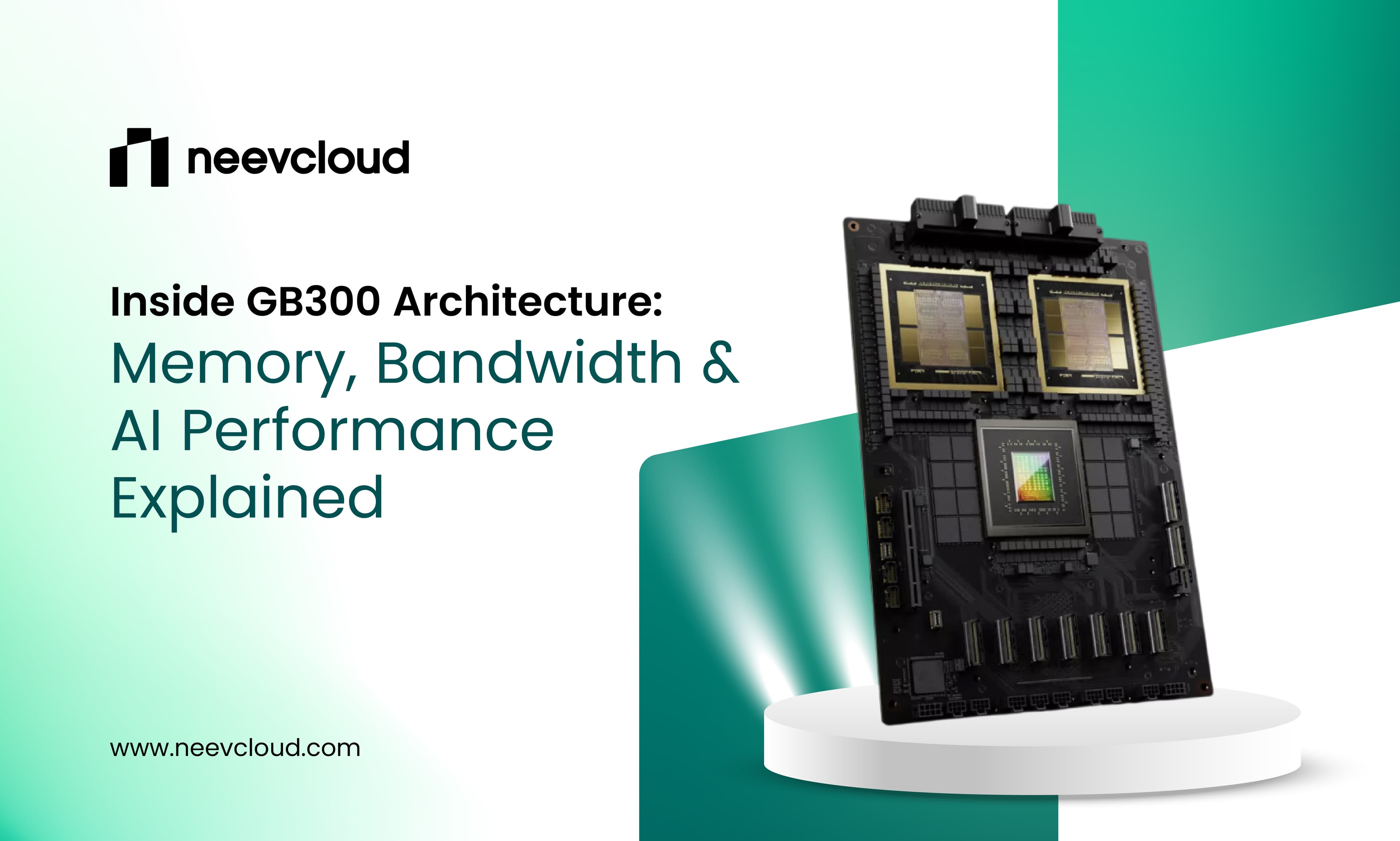
Inside GB300 Architecture: Memory, Bandwidth & AI Performance Explained
TL;DR
GB300 architecture is built to remove the biggest bottleneck in AI workloads: memory bandwidth and data movement
The combination of Grace CPU + Blackwell GPU delivers tighter CPU-GPU integration and faster model training cycles
High bandwidth memory and next-gen interconnects directly improve large language model training efficiency
Compared to previous GPUs, GB300 significantly boosts AI performance for both training and inference
For Indian enterprises, deploying such infrastructure locally enables both performance gains and data sovereignty compliance
The conversation around AI infrastructure is no longer just about compute power. It is about how fast data moves.
That is exactly where GB300 architecture changes the game.
If you are training large language models, running inference at scale, or building enterprise AI systems, your bottleneck is not cores. It is memory bandwidth, interconnect speed, and system design.
This blog breaks down NVIDIA GB300 architecture explained in practical terms. No marketing fluff. Just what actually impacts performance.
What is GB300 Architecture and How It Works for AI Workloads
At its core, NVIDIA GB300 GPU is part of the GB300 Grace Blackwell architecture, combining:
Grace CPU
Blackwell GPU
High bandwidth memory subsystem
Ultra-fast interconnect fabric
Unlike traditional GPU systems, GB300 is designed as a tightly integrated compute unit rather than separate components stitched together.
Why this matters
In AI workloads, especially:
LLM training
Generative AI pipelines
Real-time inference
The system spends more time moving data than computing.
GB300 reduces that gap.
GB300 vs Previous Generation GPUs
| Feature | Previous Gen GPUs | GB300 Architecture |
|---|---|---|
| CPU-GPU Communication | PCIe bottleneck | Direct high-speed integration |
| Memory Bandwidth | High but limited scaling | Significantly higher, optimized for AI |
| Interconnect | NVLink (earlier gen) | Next-gen NVLink with higher throughput |
| AI Performance | Strong | Built for large-scale AI workloads |
| Efficiency | Compute-heavy | Balanced compute + memory + bandwidth |
Real takeaway
Earlier GPUs scaled compute.
GB300 scales data movement efficiency, which is what modern AI actually needs.
Why Memory Bandwidth Matters in GB300 for AI Training Performance
This is the most critical part of the architecture.
The problem
When training large models:
Parameters run into billions or trillions
Data needs to be fetched constantly
GPUs often wait idle for memory
The GB300 solution
GB300 memory bandwidth is engineered to:
Feed data to compute units faster
Reduce idle cycles
Improve parallel processing efficiency
Impact on workloads
| Workload Type | Without High Bandwidth | With GB300 |
|---|---|---|
| LLM Training | Slower convergence | Faster training cycles |
| Fine-tuning | Memory bottlenecks | Smooth scaling |
| Inference | Latency spikes | Consistent response times |
Detailed Breakdown of GB300 GPU Memory Subsystem and Bandwidth Design
GB300 uses high bandwidth memory GPU architecture designed for AI-heavy operations.
Key components
HBM (High Bandwidth Memory) stacked closer to compute cores
Reduced latency pathways
Wider memory buses
Optimized caching layers
What this means for engineers
Faster tensor operations
Better utilization of GPU cores
Reduced need for excessive model sharding
In simple terms:
Your model spends less time waiting and more time learning.
How GB300 Improves AI Compute Efficiency
AI infrastructure efficiency is not just about raw power. It is about:
Throughput per watt
Work completed per cycle
Latency consistency
GB300 improves all three.
Performance comparison snapshot
| Metric | Traditional Setup | GB300-Based Setup |
|---|---|---|
| Training Time | High | Reduced significantly |
| Energy Efficiency | Moderate | Improved |
| GPU Utilization | 60–70% typical | Higher utilization |
| Data Transfer Delays | Frequent | Minimal |
This is why GB300 AI performance stands out in large-scale deployments.
How GB300 Enables Faster LLM Training and Inference
Let’s connect this to real-world use cases.
Large Language Models
Faster dataset ingestion
Reduced training time
Better scaling across nodes
Generative AI
Real-time generation improves
Lower latency in outputs
Better user experience
Enterprise AI Systems
Stable inference pipelines
Predictable performance under load
Easier scaling across environments
This is where AI workload performance GB300 becomes a practical advantage, not just a spec sheet claim.
GPU Interconnect Bandwidth for AI Workloads
One of the less talked about, but critical aspects is GPU interconnect bandwidth AI workloads depend on.
GB300 improves:
GPU-to-GPU communication
Distributed training efficiency
Multi-node scalability
Why this matters
In large clusters:
Slow interconnect = wasted compute
Fast interconnect = linear scaling
GB300 is designed for the latter.
AI Inference vs Training GPU Performance in GB300
| Aspect | Training | Inference |
|---|---|---|
| Resource Usage | Extremely high | Moderate |
| Bottleneck | Memory + compute | Latency |
| GB300 Impact | Faster training cycles | Lower latency outputs |
This balance is what makes GB300 suitable for:
Research teams
AI startups
Enterprise deployments
GB300 Architecture Impact on Generative AI Performance and Scaling
Generative AI models are getting larger and more complex.
GB300 supports this growth by:
Handling larger parameter sizes
Improving throughput
Reducing infrastructure inefficiencies
Scaling advantage
Instead of:
- Adding more GPUs inefficiently
You get:
- Better performance per GPU
That is a major shift.
Conclusion
GB300 is not just another GPU upgrade.
It is a shift in how AI systems are designed:
Memory-first thinking
Bandwidth optimization
Integrated architecture
For teams building serious AI workloads, this matters more than raw compute.
And for businesses operating in India, pairing this capability with sovereign infrastructure adds another layer of advantage.
Build Faster, Scale Smarter
If you are exploring large scale AI training GPUs or planning to upgrade your infrastructure:
Access high-performance GPU environments
Deploy closer to your users
Keep your data within India
Explore GPU cloud options or rent enterprise-grade infrastructure designed for GB300-class workloads.
FAQs
What is GB300 architecture and how it works for AI workloads?
It combines CPU, GPU, memory, and interconnect into a tightly integrated system to reduce data movement delays and improve AI performance.
How GB300 improves memory bandwidth for large AI models?
By using high bandwidth memory and optimized pathways, it ensures faster data flow between memory and compute units.
Difference between GB300 and previous NVIDIA GPU architectures?
GB300 focuses more on bandwidth and integration, while earlier architectures were more compute-centric.
Is GB300 good for large language model training workloads?
Yes. It is specifically designed to handle large models efficiently with better scaling and reduced training time.