NVIDIA GB200 vs B200: Which Cloud GPU to Choose for AI Training?

TL;DR: NVIDIA GB200 vs B200 for AI Training—Which GPU Should You Choose?
B200: A versatile, high-performance GPU for general AI workloads, real-time analytics, and adaptive cloud dashboards—best for enterprises balancing cost, performance, and flexibility.
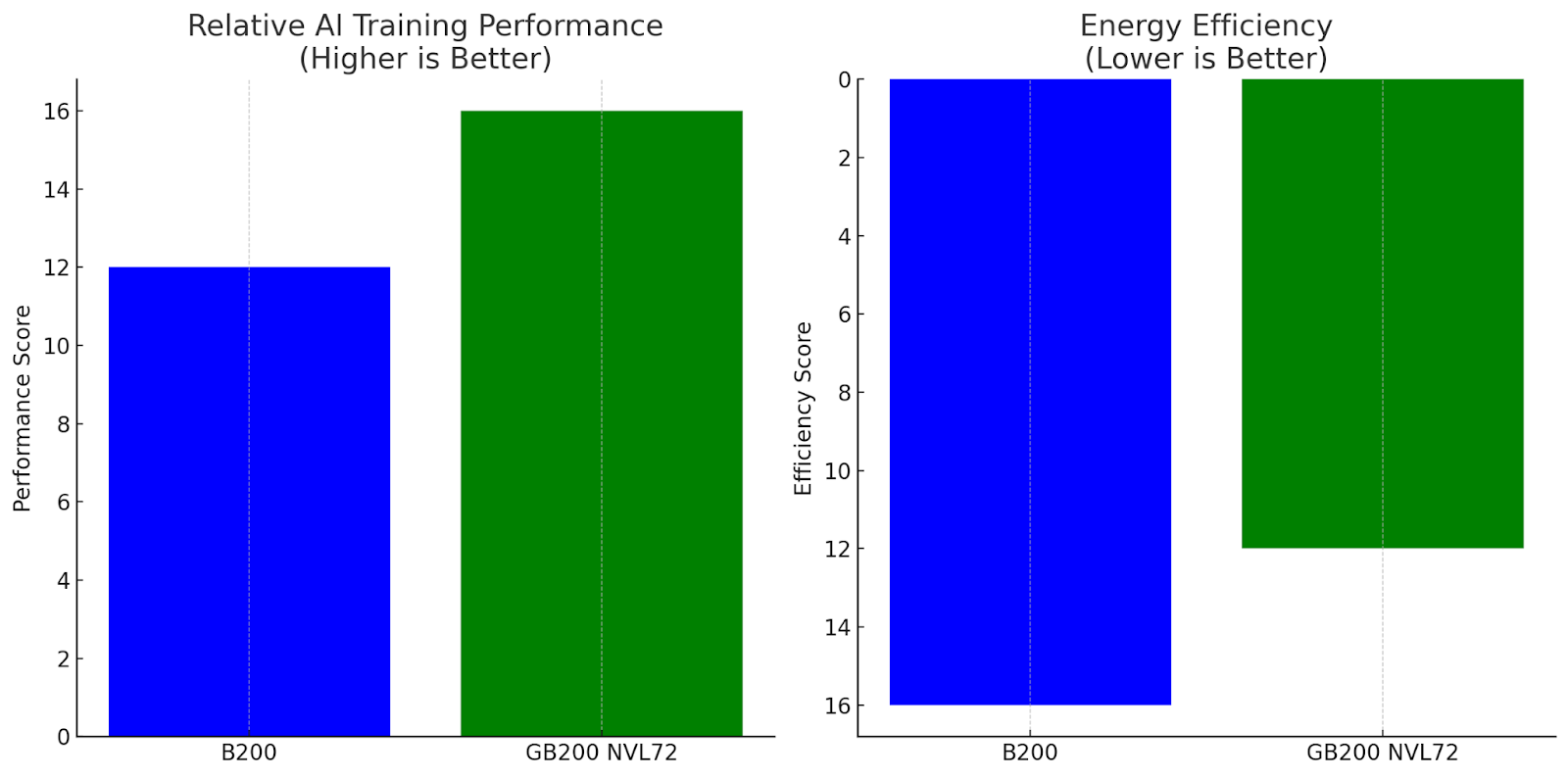
GB200 NVL72: A hyperscale AI training powerhouse optimized for trillion-parameter LLMs and generative AI—delivering up to 4x faster training, 3.5x energy savings, and 9x rack efficiency.
Use Cases: Choose B200 for flexible enterprise AI training and responsive dashboards. Choose GB200 for hyperscale AI, large-scale personalization, and data center efficiency.
Future Impact: Both GPUs will drive the next wave of AI-powered dashboards, adaptive user interfaces, and real-time personalization in the cloud.
Artificial intelligence (AI) is transforming how we interact with cloud platforms, powering everything from real-time UI updates to fully personalized dashboard experiences. As organizations race to build smarter, more adaptive cloud dashboards, the choice of GPU infrastructure becomes critical—especially for AI training workloads that demand massive computational power. NVIDIA’s latest Blackwell architecture introduces two flagship GPUs for the cloud: the GB200 and the B200. But which one is right for your AI training needs, and how do they shape the future of intelligent, AI-powered dashboards? Let’s dive deep.
1. The AI Cloud Dashboard Revolution
Before comparing the GB200 and B200, it’s vital to understand why high-performance GPUs are so essential for modern cloud platforms—especially those leveraging AI for dynamic UI generation, real-time personalization, and adaptive user experiences.
How AI Personalizes Cloud Dashboard Interfaces
AI-driven cloud dashboards analyze user behavior, preferences, and historical interactions to tailor layouts, content, and workflows for each individual. Machine learning models continuously adapt the dashboard, optimizing for engagement and efficiency. This results in:
Personalized user experiences in cloud platforms
Real-time user personalization
Cloud dashboard customization
Intelligent UI components
Real-Time UI Updates with Artificial Intelligence
The modern cloud dashboard isn’t static. AI techniques enable real-time UI updates, where interface elements change dynamically based on live data, user actions, or system events. This is made possible by:
Dynamic UI generation
AI-powered dashboards
Responsive cloud interfaces
Smart dashboards for cloud apps
Machine Learning for Adaptive UI in Cloud Apps
Adaptive user interfaces leverage machine learning to modify layouts, recommend features, and even change color schemes or widget placements—all based on ongoing user feedback and engagement metrics. This approach ensures that every user gets an interface that feels intuitive and relevant.
2. NVIDIA GB200 and B200: The Blackwell Era
NVIDIA’s Blackwell architecture represents a leap forward for AI training in the cloud. Both the GB200 and B200 GPUs are designed to accelerate large-scale AI workloads, but they serve different use cases and offer distinct advantages.
NVIDIA B200: The Versatile Powerhouse
The NVIDIA B200 GPU is built for versatility, offering exceptional performance for a wide range of AI training and inference tasks. Key features include:
Blackwell architecture: Advanced tensor cores and improved energy efficiency.
High memory bandwidth: Supports massive datasets and large model training.
Scalability: Ideal for both single-node and multi-node deployments.
The B200 is a strong choice for organizations seeking high performance without the need for the extreme scale or density provided by the GB200.
NVIDIA GB200: The AI Training Titan
The GB200 is NVIDIA’s flagship for hyperscale AI training, particularly for the most demanding workloads. Its standout features:
Second-generation Transformer Engine: Optimized for large language models (LLMs) and generative AI.
Up to 72 GPUs in a single NVLink domain (NVL72): Enables unprecedented parallelism and throughput.
1.8TB/s GPU-to-GPU bandwidth: Fifth-generation NVLink for ultra-fast interconnects.
Energy and space efficiency: Up to 4x faster training, 3.5x less energy, and 9x less rack space compared to the previous generation.
The GB200 is purpose-built for organizations training trillion-parameter models or running massive AI workloads at scale.
3. Technical Comparison: GB200 vs B200
Let’s break down the technical differences and see how they impact AI-powered cloud dashboards and adaptive UIs.
| Feature | NVIDIA B200 | NVIDIA GB200 NVL72 |
| Architecture | Blackwell | Blackwell |
| Transformer Engine | Yes (Blackwell) | Second-generation, optimized for LLMs |
| Max GPUs per System | 8 | 72 |
| Memory Bandwidth | High | Extremely High (1.8TB/s with NVLink) |
| Interconnect | NVLink | Fifth-gen NVLink + InfiniBand |
| Power Efficiency | Improved over Hopper | 3.5x better than Hopper |
| Rack Space | Standard | 9x less than Hopper for same workload |
| Target Use Case | General AI training/inference | Hyperscale AI training, LLMs, generative AI |
| Cloud Readiness | Yes | Yes |
4. Building Intelligent Cloud Dashboards Using AI
Why GPU Choice Matters for UI/UX
AI-powered dashboards depend on rapid data processing, real-time analytics, and continuous adaptation to user behavior. The underlying GPU infrastructure directly impacts:
Real-time AI for UI updates
Dynamic UI generation
Personalized cloud dashboards
Adaptive user interfaces
Cloud dashboard customization
AI Techniques for Dynamic UI Generation
Deep learning for layout optimization: Models predict the most effective arrangement of dashboard components.
Reinforcement learning for real-time adaptation: Continuously refines the UI based on user feedback and engagement metrics.
Automated UI generation: Tools like Alan AI dynamically create charts and widgets from live data, powered by GPU-accelerated inference.
Machine Learning for Adaptive UI in Cloud Apps
User segmentation: AI clusters users by behavior, customizing dashboards for each group.
Predictive personalization: Anticipates user needs, preloading relevant data or features.
Intelligent UI components: Widgets that adapt their behavior or appearance based on usage patterns.
5. Real-World Impact: AI-Driven Dashboards in Action
Personalized User Experiences in Cloud Platforms
Cloud dashboards powered by AI and high-performance GPUs deliver:
Role-based dashboards: Executives, developers, and operations teams see only the data relevant to their roles.
Smart KPI monitoring: AI prioritizes and surfaces the most critical metrics in real time.
Automated anomaly detection: Instantly flags unusual trends or performance issues.
Cloud Dashboard Customization and Responsive Interfaces
Drag-and-drop customization: Users can tailor dashboards to their workflows, with AI suggesting optimal layouts.
Real-time updates: Dashboards refresh instantly as new data arrives, thanks to GPU-accelerated inference and rendering.
Adaptive user interfaces: Layouts, color schemes, and widgets adjust dynamically for each user.
6. Performance Graph: GB200 vs B200 for AI Training
Below is a conceptual graph illustrating relative performance and efficiency for AI training workloads:
7. Use Case Scenarios: Which GPU Should You Choose?
Choose NVIDIA B200 If:
You need a flexible, high-performance GPU for a variety of AI workloads.
Your AI models are large, but don’t require hyperscale training infrastructure.
You want to balance performance, cost, and energy efficiency.
Your cloud dashboards require real-time analytics and adaptive UIs, but not at the scale of trillion-parameter LLMs.
Choose NVIDIA GB200 If:
You are training massive LLMs or generative AI models (GPT-class, multi-trillion parameters).
Your organization requires the fastest possible training times and the ability to scale to 72 GPUs in a single domain.
Space and energy efficiency are critical (e.g., for large data centers).
Your cloud platform serves millions of users with highly personalized, real-time dashboard experiences.
8. The Future: AI-Driven Frontend and Intelligent UI Components
AI in UX Design
The next generation of cloud dashboards will be defined by:
AI-driven frontend development: Automated creation and adaptation of UI components based on user data and feedback.
Custom UI with machine learning: Interfaces that evolve over time, becoming smarter and more intuitive with each interaction.
Real-time AI for UI/UX: Instant adaptation to changing data, user preferences, and business needs.
Smart Dashboards for Cloud Apps
Automated report summarization: AI condenses complex datasets into actionable insights.
Interactive visualizations: Users explore data through AI-generated charts, graphs, and widgets.
Predictive analytics: Dashboards forecast trends and recommend actions, powered by GPU-accelerated ML models.
9. Conclusion: GB200 vs B200—The Right Choice for Your AI Cloud
Choosing between the NVIDIA GB200 and B200 depends on your organization’s scale, AI ambitions, and the level of personalization and intelligence required in your cloud dashboards.
For most enterprises and cloud platforms building intelligent, adaptive dashboards, the NVIDIA B200 offers outstanding performance, flexibility, and efficiency.
For hyperscale AI training, LLMs, and platforms delivering real-time, deeply personalized experiences to millions, the NVIDIA GB200 NVL72 is unmatched in speed, scalability, and energy savings.
Both GPUs are ready to power the next generation of AI-powered dashboards, responsive cloud interfaces, and adaptive user experiences. As AI continues to reshape the cloud, your choice of GPU will be the foundation for innovation, efficiency, and user delight.
Explore more about NVIDIA GB200 NVL72 and B200 at NeevCloud to find the right solution for your AI cloud journey.