The Role of GPUs in AI Cybersecurity Deployment

GPU acceleration is becoming the backbone of AI-driven cybersecurity. From real-time threat detection to automated incident response and generative AI defense, GPUs provide the scale, speed, and intelligence needed to counter today’s sophisticated attacks. Cloud and edge deployments make it easier for enterprises to adopt, while industry leaders like NeevCloud and NVIDIA are powering the next wave of AI-driven cyber defense.
TL;DR: How GPUs Power AI Cybersecurity
GPUs process massive datasets 600x faster than CPUs for real-time defense.
Enable advanced AI use cases: threat detection, SOC automation, phishing/malware defense, and generative AI.
Scale seamlessly with cloud GPU infrastructure and edge AI deployments.
Best GPUs: NVIDIA H200, A100, and GB200 NVL72 for different security workloads.
Case studies (Darktrace, Vectra AI) show real-world impact in reducing response time.
By 2025, 80%+ enterprises will rely on GPU-powered AI cybersecurity solutions.
Introduction
The digital landscape is evolving at an unprecedented pace, and with it, the sophistication and volume of cyber threats are escalating. Organizations are turning to AI in cybersecurity to keep pace with these challenges, leveraging the immense computational power of GPUs for AI to build, train, and deploy advanced cybersecurity AI solutions. As the backbone of modern cybersecurity infrastructure, GPU computing is transforming how enterprises detect, prevent, and respond to cyber threats.
This comprehensive article explores the critical role of GPU acceleration for AI in cybersecurity, the latest advances in deep learning cybersecurity, and how GPU-powered AI systems for cybersecurity are redefining the future of digital defense.
Why GPUs Are Essential for AI Cybersecurity
The Computational Demands of AI in Cybersecurity
AI-driven cybersecurity solutions—such as real-time threat detection, automated incident response, and advanced malware analysis—require the processing of massive datasets and the execution of complex algorithms. Traditional CPUs, while versatile, are not optimized for the parallel workloads inherent in machine learning cybersecurity tasks. In contrast, GPUs (Graphics Processing Units) are designed to handle thousands of simultaneous operations, making them ideal for both AI model training and inference.
“GPUs have become the workhorse of modern artificial intelligence, enabling the training and deployment of complex AI models that power everything from image recognition to natural language processing.”
Accelerated Computing: The GPU Advantage
Parallel Processing: GPUs contain thousands of cores, enabling them to process multiple data streams simultaneously—a necessity for high-speed analysis in cybersecurity.
Faster Model Training: AI model training on GPUs can be up to 600x faster than on CPU-only systems, drastically reducing the time to develop and deploy new models.
Real-Time Inference: For real-time cyber threat detection, GPUs deliver the low-latency performance required to analyze network traffic, user behavior, and application logs as events unfold.
Key Use Cases: AI and GPU Computing in Cybersecurity
1. Cyber Threat Detection AI
AI-powered threat detection systems use deep learning and machine learning to identify anomalies, malicious patterns, and emerging threats across vast datasets. GPU acceleration for AI enables these systems to:
Analyze billions of network events per day.
Detect threats in encrypted traffic using deep packet inspection.
Identify zero-day attacks and advanced persistent threats (APTs) by learning from historical and real-time data.
2. Automated Incident Response
Cyber defense AI platforms leverage GPUs to automate the detection, analysis, and remediation of security incidents. This reduces response times from hours to minutes and allows security teams to focus on strategic tasks.
3. Malware and Phishing Detection
Modern malware and phishing campaigns evolve rapidly. AI models trained on GPUs can:
Continuously adapt to new attack vectors.
Analyze code samples at scale for malicious signatures.
Deploy rapid countermeasures to prevent breaches.
4. Generative AI Cybersecurity
Generative AI is now being used to simulate attack scenarios, test defenses, and even generate synthetic data for training more robust models. GPUs make these resource-intensive tasks feasible at scale.
5. AI SOC (Security Operations Center)
Next-generation AI SOCs use GPU-powered analytics to monitor every server, packet, and user in real time. This holistic visibility is crucial for detecting lateral movement and coordinated attacks.
How GPUs Improve Cybersecurity Model Performance
Performance Metrics
Throughput: GPU-powered systems can process up to 600x more data per second than CPU-only systems.
Latency: Real-time inference is achievable, enabling instant threat detection and response.
Scalability: GPU clusters can be scaled horizontally to handle spikes in network traffic or security events.
Example: GPU Acceleration for Deep Learning in Cybersecurity
A deep learning model for intrusion detection might require millions of parameters and terabytes of training data. GPU acceleration enables:
Faster convergence: Models reach optimal performance in hours, not days.
Larger models: More complex architectures can be trained without memory or compute bottlenecks.
Continuous learning: Models can be updated in near real-time as new threats emerge.
Deploying AI-Based Cybersecurity Solutions with GPUs
Cloud-Based GPU Infrastructure
Providers like NeevCloud offer enterprise-class, cloud-based GPU infrastructure optimized for AI security solutions. Key features include:
Bare-metal performance without infrastructure overhead.
Distributed, fault-tolerant storage for secure data handling.
Integrated network fabric for efficient routing, switching, and firewall capabilities.
“NeevCloud’s advanced GPU Cloud infrastructure enables organizations to launch large clusters of compute nodes with zero DevOps required, supporting the rapid deployment of AI-based cybersecurity solutions.”
Edge AI in Cybersecurity
With the rise of IoT and edge computing, deploying AI-powered cyber threat detection at the edge is increasingly important. GPUs enable:
On-device inference for real-time threat detection.
Reduced data transfer to central servers, preserving bandwidth and privacy.
Autonomous response to local threats without human intervention.
Best GPUs for AI Threat Detection Models
When selecting the best GPU for AI threat detection models, consider:
| GPU Model | Memory (GB) | Cores | Key Use Case |
| NVIDIA H200 | 141 | 14,592 | Deep learning, real-time SOC |
| NVIDIA A100 | 80 | 6,912 | Model training, inference |
| NVIDIA GB200 NVL72 | 192 | 18,432 | Large-scale AI clusters |
NeevCloud offers access to the latest NVIDIA GPUs, supporting both startups and enterprises in building next-generation AI-powered cybersecurity systems.
Real-World Examples and Case Studies
Darktrace: Self-Learning AI for Real-Time Threat Detection
Self-learning AI adapts to network behavior without manual rules.
Real-time detection and autonomous response capabilities.
Cyber AI Analyst automates investigation and reporting, reducing triage time from hours to minutes.
Vectra AI: Continuous Monitoring with Machine Learning
Continuous, real-time monitoring of entire digital ecosystems.
Automated threat prioritization using machine learning.
AI-powered threat hunting across on-premises and cloud environments.
AI Model Training and Deployment for Security Analytics
Training AI Models on GPUs
Data Ingestion: Massive volumes of network, endpoint, and application data are ingested.
Model Training: GPUs accelerate the training of deep neural networks, enabling rapid iteration and improvement.
Validation: Models are validated against historical attack data to ensure accuracy.
Deployment: From Cloud to Edge
Cloud Deployment: Centralized models deployed on GPU clusters for enterprise-wide protection.
Edge Deployment: Lightweight models pushed to edge devices for localized, real-time defense.
Statistics: The Impact of GPUs in AI Cybersecurity
600x Faster: GPU-accelerated AI inference can be up to 600 times faster than CPU-only systems for real-time monitoring.
80% of Enterprises: By 2025, over 80% of enterprises are expected to adopt AI-powered cybersecurity tools, most of which will rely on GPU acceleration (industry estimate).
$46 Billion Market: The global AI in cybersecurity market is projected to reach $46 billion by 2027, driven by rapid adoption of GPU-powered solutions (industry estimate).
GPU Acceleration vs. CPU in Cyber Threat Detection
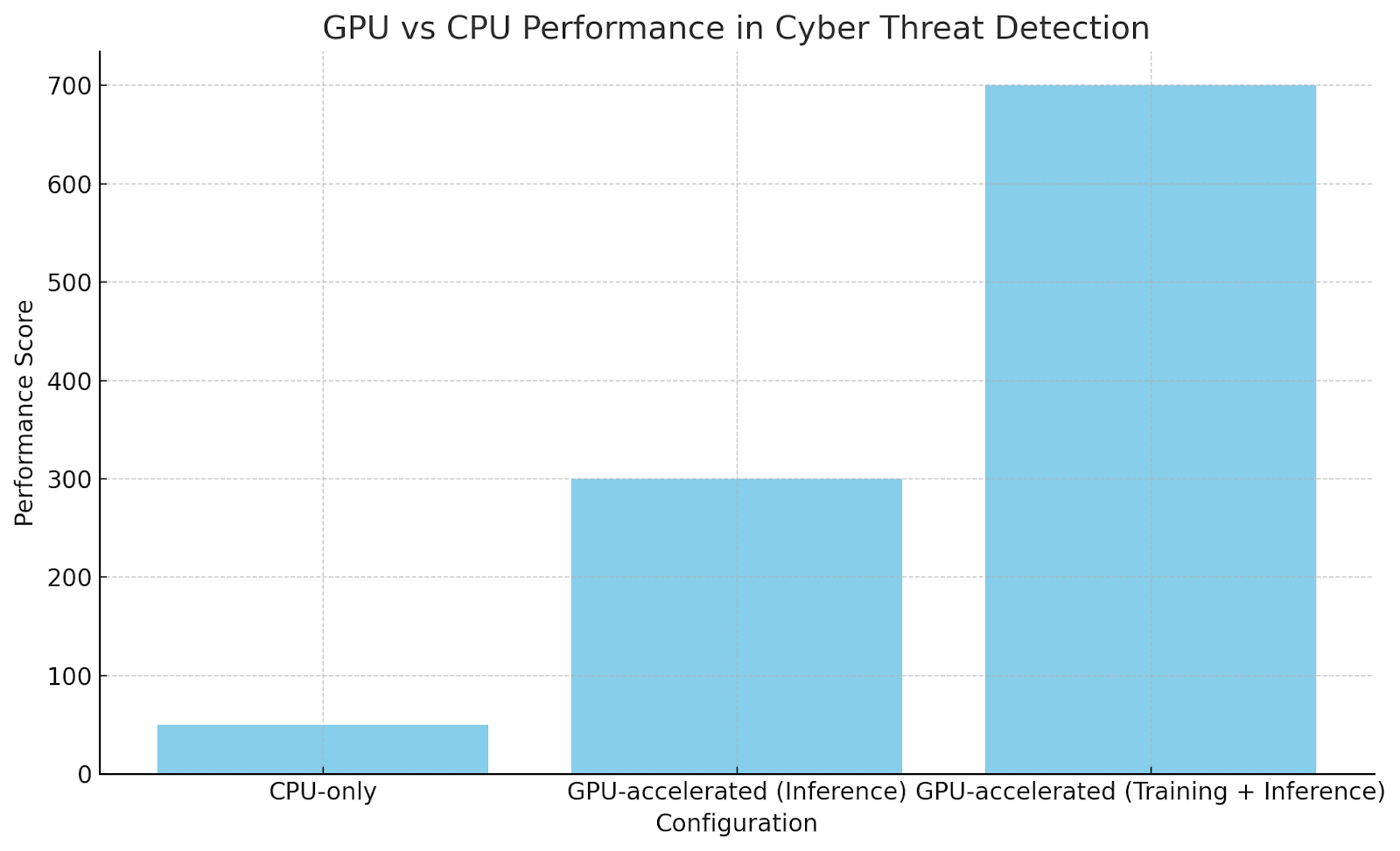
Y-axis: Relative Performance (Events/sec); X-axis: System Configuration
The Future: Generative AI and Autonomous Cyber Defense
Generative AI cybersecurity is set to revolutionize threat simulation, vulnerability assessment, and automated response. By leveraging GPU-powered AI systems, organizations can:
Simulate complex attack scenarios for proactive defense.
Generate synthetic data to train more resilient models.
Automate the entire threat lifecycle, from detection to remediation.
Conclusion
GPU computing is not just a performance booster—it is the foundation of modern AI security solutions. As cyber threats grow in complexity and scale, the integration of GPU acceleration for AI is essential for building resilient, real-time, and adaptive cybersecurity defenses. From AI model training on GPUs to deploying AI-powered cyber threat detection using GPU clusters, the synergy between GPUs and AI is ushering in a new era of digital security.
For organizations seeking to stay ahead in the cybersecurity arms race, investing in GPU-powered AI systems for cybersecurity is no longer optional—it is mission-critical. Providers like NeevCloud are making this transition seamless, offering scalable, secure, and high-performance GPU infrastructure tailored for the demands of AI in cybersecurity.